

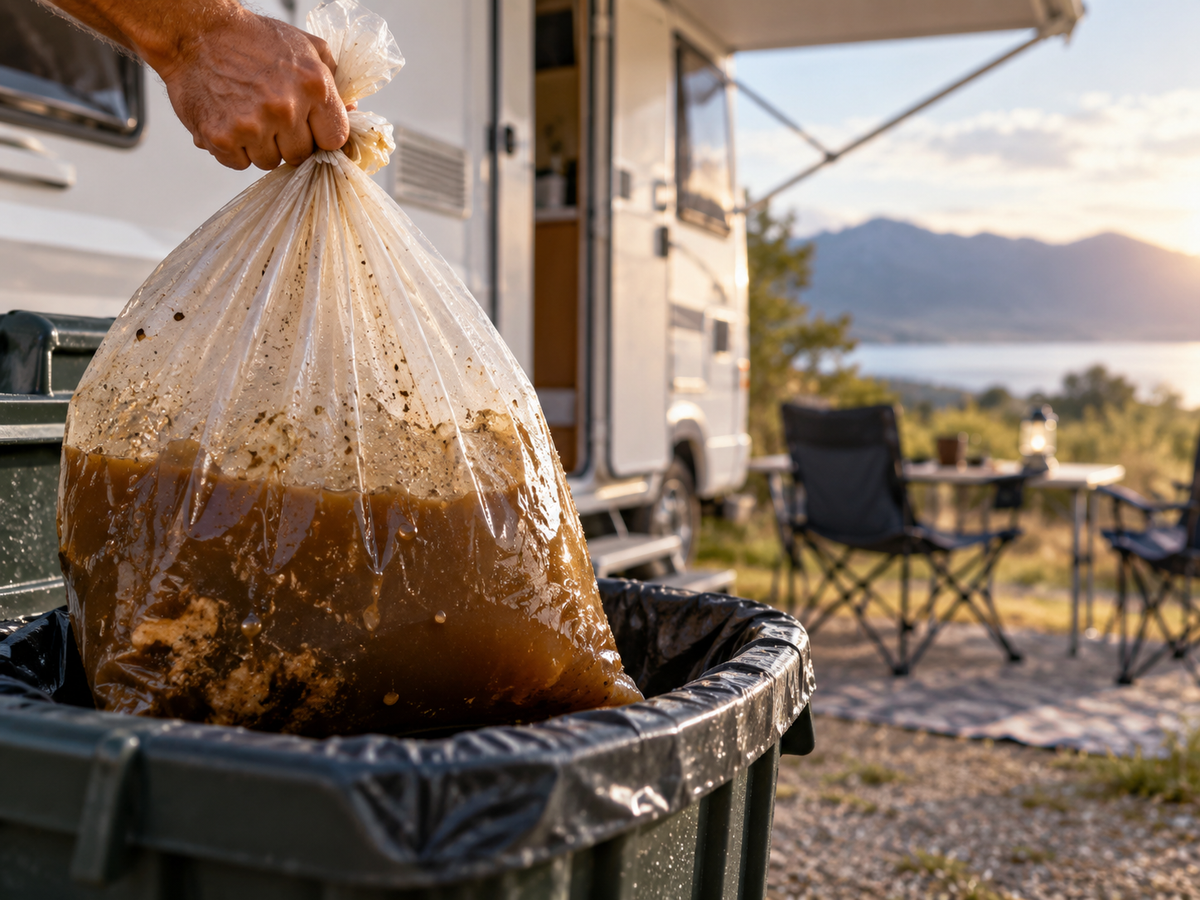
"New technology". Same old sewage.
The latest non separating bagging and heat-sealing toilets certainly look impressive. Press a button, the waste disappears into a sealed bag, and you’re done. No chemicals, no dump points, no messy cassette. Brilliant, right?
Except the toilet hasn’t actually treated anything.
When urine and faeces are mixed together, you’re creating the same unpleasant sewage mixture that traditional chemical toilets have dealt with for decades. Only now, instead of managing it, you’re wrapping it in plastic.
The electronics might be clever and the sealing mechanism sophisticated, but putting raw sewage in a bag isn’t waste treatment. It’s packaging. And there’s nothing revolutionary about that.
Even chemical toilets have a better plan.
Let’s face it, nobody enjoys emptying a chemical toilet. But at least the system makes sense. Chemical toilets use additives to manage waste and odours, then provide a dedicated disposal pathway through dump points and sewage infrastructure. It’s not glamorous, but it’s responsible.
Mixed-waste bagging toilets skip the treatment and the dump point. Instead, untreated raw sewage is sealed in bags and sent to the general rubbish system, where permitted.
We’ve gone from dedicated sewage disposal to throwing bags of raw sewage in the bin. How exactly is that an improvement?
Your waste. Somebody else’s problem.
This is what really bothers us about the bagging toilet revolution. We’ve become so obsessed with convenience that we’ve forgotten about responsibility.
Seal it, bin it, forget it. Except it doesn’t disappear. Someone collects that rubbish, someone transports it, and someone manages the landfill where it ends up. And what happens when a bag splits?
You’ve made your waste disappear from your caravan. You’ve simply made it somebody else’s problem.
As travellers, we’re expected to take responsibility for our rubbish, our campsites and our environmental impact. Why should human waste be any different? It’s your waste, and surely managing it responsibly isn’t too much to ask.
We banned plastic straws. Now we’re wrapping raw sewage in plastic?
Seriously, think about that. We’ve spent years reducing single-use plastics. Shopping bags, straws, cutlery and plates. We’ve been encouraged to reuse, recycle and reduce unnecessary waste.
Yet now we’re paying thousands for toilets that mix urine and faeces together, creating raw sewage, before sealing it in single use sometimes medical grade plastic bags. And those bags aren’t free.
Depending on the system, every sealing cycle means another consumable to purchase, carry and eventually throw away. For full-time travellers, that can add up to hundreds of bags of untreated sewage heading into the rubbish system every year.
Surely genuine innovation should reduce waste, not create another disposable product to wrap it in.
Thousands for the toilet. More $$$$ to wee in a bucket?
And just when you thought things couldn’t get more ridiculous, some mixed-waste bagging toilets are now offering separate urine-collection buckets as accessories. An accessory to deal with what you do most of the time you go to the toilet!
Think about that for a moment. You’ve spent thousands of dollars on a sophisticated, high-tech toilet, only to be offered an expensive bucket to wee in.
Why? Because collecting and sealing urine along with solids creates problems with liquid volume, bag consumption and waste handling. Offering a separate urine bucket looks like a clear acknowledgement of the limitations and cost of running a non separating bagging toilet.
And here’s the “really clever” bit. You now need to decide what you’re going to do before you sit down. Just a wee? Get the bucket ready. Something more substantial? Better make sure you’ve chosen the right setup. Heaven forbid you change your mind halfway through!
Meanwhile, urine-diverting toilets have been separating liquids and solids from the beginning, without the need to swap buckets or make bathroom decisions in advance.
So, we’ve spent thousands developing and buying a high-tech toilet that mixes everything together, only to discover that disposing of urine separately was a good idea after all. And now they’re charging more $$ for a bucket to do it.
You really couldn’t make this stuff up.
Urine-diverting toilets: Stop creating sewage in the first place.
What if we didn’t mix urine and faeces together to begin with?
That’s the fundamental difference with urine-diverting toilets. By separating waste at the source, you avoid creating that wet sewage mixture in the first place. And once separated, there are smarter ways to manage each waste stream.
Composting toilets keep solids dry and use an appropriate composting medium to start biological decomposition. The result is no odour, less mess and much less urgency to empty the solids. Depending on usage, you can go weeks or even months before emptying the solids container.
Other urine-diverting technologies, including solids-only sealing systems, contain faeces separately without mixing them with urine. While sealing alone doesn’t treat the solids, it avoids creating bags of mixed raw sewage, reducing plastic use and landfill by about 80-90%. Most of the time we go to the loo we are just doing a wee anyway!
And because the waste streams remain separate, there is more flexibility in how they’re responsibly managed and disposed of, subject to local requirements.
The clever part isn’t necessarily what happens after you use the toilet. It’s avoiding the creation of mixed sewage in the first place.
So what are we actually achieving?
Chemical toilets mix waste, use additives to manage it, and send it to dedicated sewage disposal facilities.
Mixed-waste bagging toilets also mix waste, but don’t treat it. Instead, they package raw sewage for the rubbish system.
Urine-diverting toilets take a fundamentally different approach. By separating liquids and solids from the beginning, they avoid creating mixed sewage and allow each waste stream to be managed appropriately. Composting systems go a step further by encouraging biological processing of the solids.
One manages sewage. One packages sewage. And one avoids creating mixed sewage in the first place.
That’s a pretty significant difference when you look beyond the marketing and consider what actually happens to the waste.
Are we moving forward or backwards?
We’re all for making caravanning easier, but convenience shouldn’t mean passing responsibility to somebody else. Expensive technology isn’t automatically better technology.
We’ve spent decades improving sanitation and reducing unnecessary plastics. Now we’re celebrating toilets that mix human waste together, wrap the resulting raw sewage in disposable bags and send it off with the rubbish.
And when that approach proves inconvenient for urine, the solution is apparently to sell you another bucket.
That’s not a revolution in waste management. It’s a very expensive way of avoiding it.
Maybe it’s time we stopped asking how quickly a toilet can make our waste disappear and started asking what actually happens to it. Because managing our waste responsibly shouldn’t end the moment we can no longer see it.
Your waste. Your responsibility.
The future of caravan sanitation isn’t a more expensive way to bag raw sewage. And it certainly isn’t an expensive bucket added to a toilet already costing thousands.
It’s designing the toilet properly in the first place.
Compo Closet Australia — Rethinking how we manage human waste.
Share:
Cuddy Venting Carbon Filter: Reduce Moisture Without Drilling