Why Did a Composting Toilet Company Make a Bag-Sealing Toilet?
Fair question. We spend most of our time telling people composting is the smarter way to deal with their business on the road, and then we went and launched the S1 Dry Flush, a bag-sealing toilet. Did we lose our nerve?
No, and here's why.
Composting is still our answer for long-term travel
That hasn't budged. For anyone doing serious time off-grid, weeks between dump points, months in the outback, the Cuddy is still the one we'd put our money on, and it's not close. Nothing to bag every time you go, fewer consumables to restock, cheaper to run, and less rubbish leaving the van. For the long haul, composting wins (our composting toilet buying guide covers the full case for it, if you want the detail).
But "best for the long haul" isn't "right for everyone." Some people just want to sit down, do their business, and not think about a carbon medium. That market was never going away. So we asked a simpler question: if people are going to buy a bag-sealing toilet anyway, why does it have to waste something useful to do it?
The problem: every other sealing toilet treats your wee like rubbish
Look at any other dry flush toilet on the market. Solids and liquids, all one bag, sealed and binned, every single time, for everything. We've actually written a whole post on where that leads: Mixing Human Waste Together in Sealed Plastic Bags, Is That Really Progress?
Which means every quick wee gets its own little plastic parcel, sent straight to landfill. Do the maths on a few weeks of travel and that's a genuinely silly amount of plastic, generated for liquid that's mostly water and didn't need bagging in the first place.
Because here's the bit competitors seem to have missed: urine isn't waste. It's nutrients with a marketing problem, and unlike solids, there's usually a perfectly easy, "natural" way to deal with it wherever you are.
Your wee, defended: 3 things it's actually good for
We're not asking you to get sentimental about it. Just look at the research:
It's basically fertiliser. Urine carries 80–85% of the nitrogen and roughly two-thirds of the phosphorus your body excretes, the same nutrients you'd buy in a bag from Bunnings. One adult's daily output has enough in it to grow a loaf of bread's worth of wheat. Rich Earth Institute trials have grown hay, hemp and sweet corn just as well on diluted urine as on synthetic fertiliser, and phosphorus, mined, finite, and possibly peaking within a decade, is not something we should be flushing away for fun.
It saves your local waterways a headache. Wastewater treatment plants spend real energy stripping nitrogen and phosphorus out of everything we flush, because too much of it ending up in rivers and dams feeds the algal blooms nobody wants. Divert it at the source and there's less of that load to treat in the first place.
It doesn't need a bag. It needs a toilet, dump point, or bush. Unlike solids, urine can go into an actual loo, a dump point, or a urinal almost anywhere. And failing all of that, tipped away from water it's fine, it was always headed back into the environment one way or another.
None of that describes a sealed bag in a bin.
So the S1 doesn't waste yours
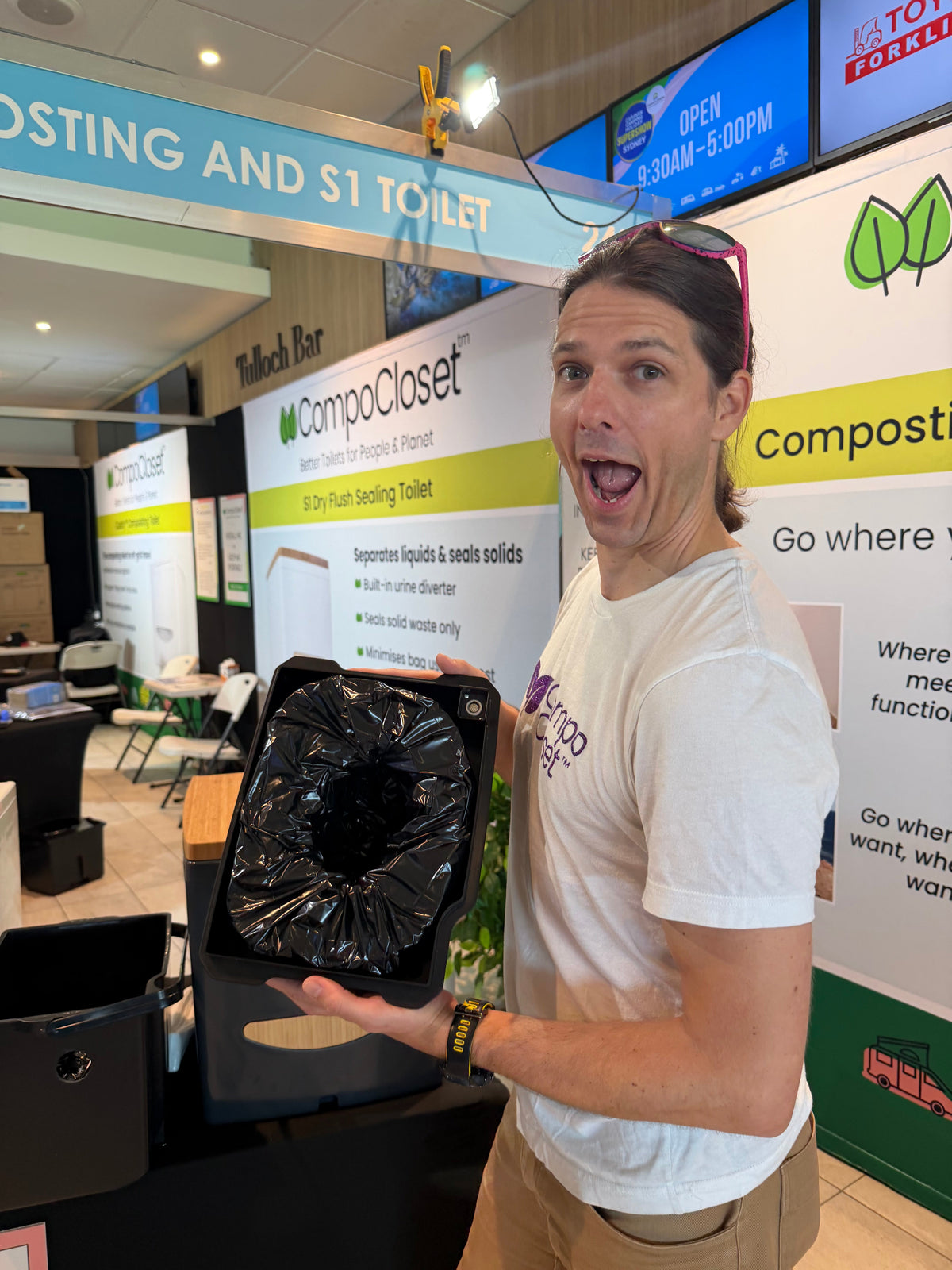
The S1 Dry Flush is the world's first sealing, dry flush toilet with a built-in urine diverter: same liquid/solid split as our composting toilets, just paired with a heat-sealer instead of a compost chamber. Liquids go into a 6.5L tank with an LED warning light, good for about 20 uses before it needs tipping out. Only solids ever touch a bag.
Fewer bags, less landfill plastic, lower running cost. Or, as we like to put it: you don't pay to pee, and nor does the planet.
Still a sealing toilet, quick, low-maintenance, nothing to compost, nothing to think about. Just one built by people who couldn't stomach bagging something that useful.
So which one's for you?
Doing long stretches off-grid and want the lowest running cost over time? Still the Cuddy (or Cuddy Lite).
Want the simplicity of a sealing toilet without sealing your own urine into landfill on repeat? That's the S1. (Our full toilet comparison guide breaks it down feature by feature, if you're still torn.)
And if you genuinely can't decide, here's the kicker: you don't have to. Every Compo Closet toilet is interchangeable, a Cuddy or Cuddy Lite converts into an S1, and an S1 converts back, whenever your trip changes. Best of both worlds, built in.
Our position hasn't moved an inch, we just built a second way to get there.


Share:
Cuddy Composting Toilet Review: What Unsealed 4X4 Found